Sunday, November 6, 2011

Islanders for a Day: Island Living at Bolobadiangan Is., Concepcion, Iloilo

Part 2/3: Killing Time in Concepcion

I had three hours to spare before the boatmen picked me up at 4pm, so after I ate lunch with Ricky, Concepcion’s Tourism Office Staff, I walked around town with him as my guide.

Concepcion is approximately two and a half hours away from Iloilo City if you take HPQ bus. You can find it at Tagbak Terminal in Jaro District. HPQ bus is the only one that plies the Iloilo City-Concepcion route. Fare is P120. But if you want to get there thirty minutes earlier, you can ride an HPQ van found also in the terminal. Travel time is approximately two hours.

According to its official website, Concepcion is a 4th class municipality in the northern part of Iloilo province. It is composed of 16 islands, 11 of which are island barangay. Fishing is the primary source of livelihood, subsistence farming the second. Tourism may very well be the next big income generating industry for the municipality although the tourism officers I talked with admitted that they were still not ready for tourists. Although there are already available inns at the town proper (Jun Bee, for one), there are almost none in the islands for tourists, except for the Sandbar Island Resort at Bolobadiangan Island. Island transfers still need to be organized because at present if one needs a pump boat, Ricky has to text them. Problem is, sometimes the boatmen can’t receive the text messages on time because there’s no signal in their island.


On the other side of the port, fishermen help 'park' a boat ashore
Ricky and I first went to the fish port, which also serves as a dock for passenger boats carrying people plying between their homes in one of Concepcion’s 16 islands and the mainland where the town proper is. I noticed though that there were many smaller boats docked in the fish port. Ricky told me they are privately owned by fish buyers who in turn sell it in their barangay. 
Small boats owned by fish buyers from other islands docked at the port

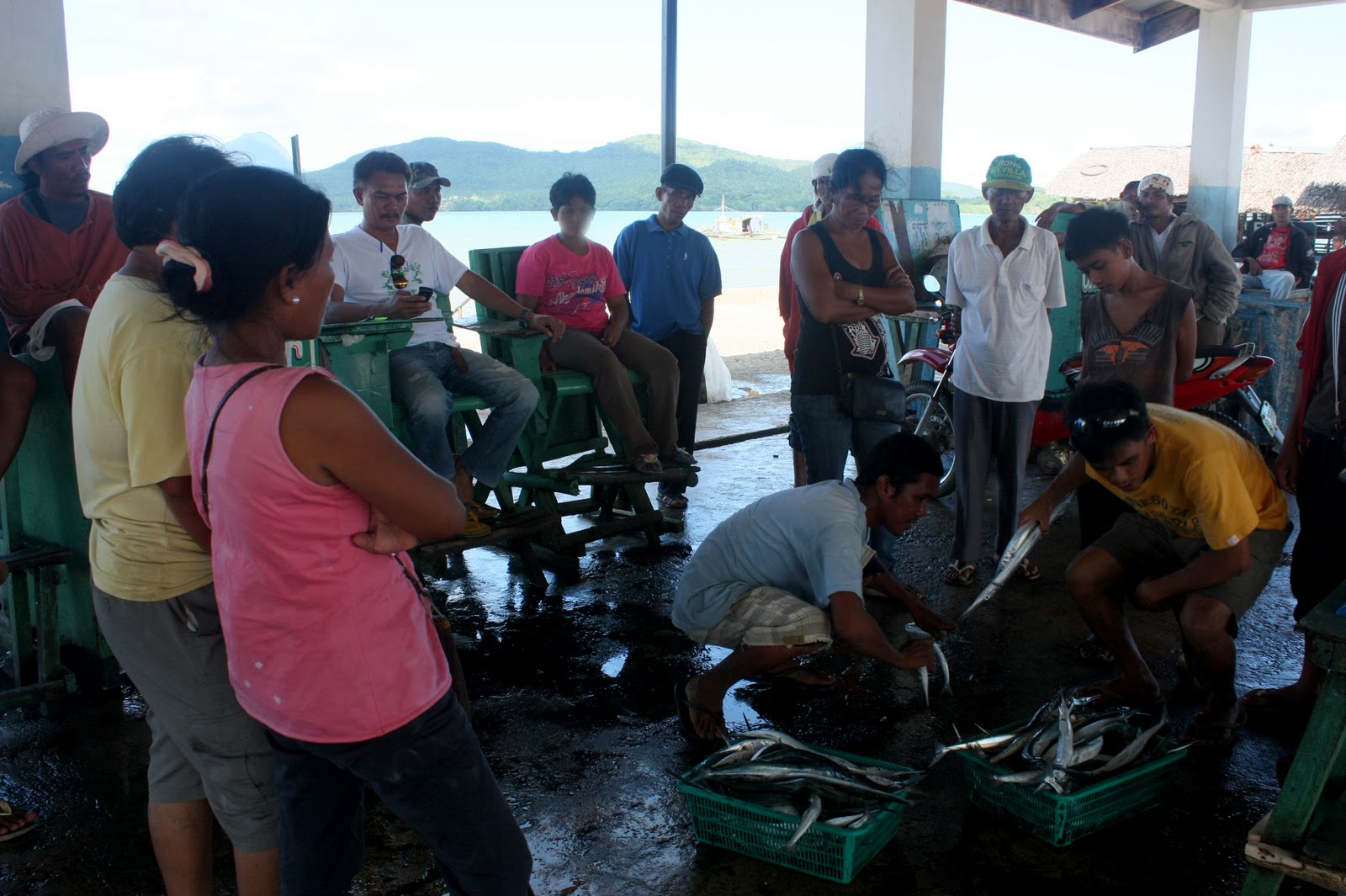
It was my first time to be in a fish port so I was not aware on how business is done there. The process is like this: the fishermen go out to the sea, catch fish, then go back to the port. They then bring their catch to a fish broker stationed in the port. The fish broker will be the one to set the price for the fish caught. Pricing is arbitrary. When I asked Ricky where the brokers base the price, he said they just know it. The selling price includes the broker’s commission and the fisherman’s pay. Now, the fish buyers from other barangay, including those from the islands, can only buy fish through a broker--they cannot buy directly from a fisherman even though that would mean buying fish at way, way cheaper price.

Why? I asked Ricky.
He said it’s just the way it is.
What does the municipality do about it?
That’s the way it is, he said.
A fish broker
Negotiations between sellers and buyers of fish
Fishermen, brokers and buyers gather at the port for the afternoon catch


After the fish is bought, it is repacked ready to be sold to people in other barangay
So you see, the system allows the fishermen to be exploited. Not only that. People who will buy from the buyers will now have to pay more for the fish. “That’s the way it is.”

I don’t know if Concepcion’s case is the same as with other fish ports, but after I learned about these, I could not help but feel sorry for the fisher folks--they get the least amount of money but they get to do all the work. Their take-home pay is only enough to buy food for their family for a day. Ricky told me that sometimes, the fishermen in the islands exchange their catch for rice or meat or vegetables with the other villagers. The brokers, however, get the biggest chunk of money from it with only their saliva as capital. Ricky told me that these fish brokers have become well-off because of their trade.

We then went to the town’s polytechnic college a few meters away from the fish port. It is called the Northern Iloilo Polytechnic State College, where Ricky finished college. It’s a relatively small campus but probably enough for a small town like Concepcion. Like most state colleges, government neglect is apparent in its dilapidated classrooms. There are two main buildings, a breeding facility, an open field, and a viewing deck overlooking the Visayan Sea dotted with islands. It was simply magnificent! The view was just breathtaking.
The School in Town

As seen from the viewing deck 
From the viewing deck, we can see Pan De Azucar, where Mt. Manaphag is located. According to Ricky, its summit can be reached within three hours--that is if the one who will climb its steep slopes is an experienced mountain climber (I bet it will take me double that time to reach the top). Rolling hills in the middle of the sea, an illusion formed by the other islands (oh memory, why do you make me forget their names?), can also be seen.

We spent a lot of time in the viewing deck discussing the future of Concepcion as a tourism hotspot, the illegal commercial fishing that affects their fishermen, and environmental issues it faces. Ricky also lamented on the lack of experts on Fisheries in their town. He said that most students in their town take up computer-related courses because of the demand in the market; however, what is needed in their hometown are courses in environmental science or fisheries.

It used to be that the polytechnic college offers a course in Fisheries, but now it specialized in Education. If a student wants to study Fisheries, he or she has to enroll either in UP Visayas (in Miag-ao), which specialized in it, or in another university (blame my unreliable memory) in the city.

Problem is, there are only few students who take the UPCAT and could afford studying far from home. I told him about the AAP (Affirmative Action Program) of UPLB Pahinungod wherein volunteers are sent to underserved communities to conduct lectures in subjects covered in college entrance exams. Maybe we can conduct one in Concepcion, I told him. He seemed interested although I saw a hint of hesitation after I told him that the LGU or another funding agency should sponsor the expenses of the volunteers.
Ricky Galvan, Municipal Tourism and Environment Officer.
He's also into hand painting souvenir t-shirts like the one he's wearing.
I understood his hesitation given the little budget Concepcion has. Ricky mentioned that in safeguarding their waters from illegal commercial fishing boats alone, the budget is limited. So I told him again about the rich potential of tourism for their town’s income.

When I started my trip, my problem was where to go. It was selfish, as a friend told me, given the problems of the world. It turned out that my selfish wants would lead me to understanding the problems of the world.

Islanders for a Day: Island Living at Bolobadiangan Is., Concepcion, Iloilo

Part 1/3: E la voce di Dio (or The misadventures caused by the voice of my god)

The end of October is usually meant for a reenergizing lakwatcha since the semester has only ended and the next is just few days away. Originally, I was scheduled to go to Lake Sebu via GenSan (General Santos City, South Cotabato), but it did not push through. The long and short of it is that I missed my flight because I overslept—to think that my flight is at 12.35 pm! (I’ll have to write a separate blog entry on this adventure).   Oh well, as my friend said, รจ la voce di Dio (it’s the voice of God).
Lake Sebu, where I was supposed to go
Photo from lakesebuphilippines.blogspot.com
 Maybe my god has other plans for me. It was not easy to learn of this plan though. I stayed at the airport for about three hours thinking of where to go. I could have bought a new ticket to GenSan or Davao had the ticket not cost me an arm and a leg. I have a few places in mind but could not decide where to finally spend four days. I was already in lakwatcha mode, so to speak, and all I was certain about is that I needed to have a vacation after all the stress of checking jillions of papers. I badly needed it to clear my mind, unload it of unhealthy thoughts and ready it for the coming mental stress of the next semester.

I thought of going back to Bagasbas in Daet, Camarines Norte to surf and finally go to Calaguas Island. I texted my college friends if they want to join me, but when they knew that we have to leave on that very same day, they said they’ll take a rain check. I don’t blame them. Only a crazy person like me will take that trip. Then I thought about going to Sagada but gave up on it since my friends and I have an annual pilgrimage to it in December. Then I thought of the 16 islands of Concepcion, Iloilo and imagined myself letting time pass listening to waves and marveling at the vastness of the sea and the night sky. I suddenly realized how I desperately longed for the calmness of the sea.

Now, Iloilo is unlike any other city for me. It holds a special corner in my heart, and when I think of going there, there is always a struggle between going and not going. A special consideration should be made; otherwise, the lakwatcha trip is a disaster waiting to happen.

My friends' prodding to go to Iloilo instead of Bagasbas (I already called the bus liner to inquire about their trips to Daet) gave me confidence to finally purchase that golden ticket. But my god would not make it easy for me. The ticket to Iloilo cost more than that of GenSan or Davao. I went to another airline and its staff said all flights for the day were fully booked, and I could not just afford the cost of the next earliest flight.

What I finally did was to book the earliest flight to Bacolod and go to Iloilo via a two-hour ferry ride. Fortunately, I could afford the ticket even though it’s still a bit pricey. Talk about will power.

Iloilo, Finally

I’ll skip my Bacolod adventure for now and write a separate entry on that. I was in Iloilo City in the morning of Oct. 28, but I scheduled my trip to Concepcion the next day so I can take a rest and jog at Iloilo Boulevard in the afternoon (I’m training for a full marathon in March so I can’t miss a run).

Balay Ilonggo inside UP Visayas in Iloilo City

Across Balay is UPV's Main Library, which is formerly the City Hall

The next day, I went to Tagbak Bus Station in Jaro at around 9 am. From Balay Ilonggo at UP Visayas, where I stayed for the night, I rode a jeepney going to Leganes. Fare is P12.00. At the terminal I rode the HPQ bus, which is the only one going to Concepcion. It is not an air-conditioned bus but I did not mind because I expected that the air is fresh and clean, so fresh and clean that I could not help myself falling asleep during the trip (my friends have a nickname for me: troso).

I awoke at Ajuy, the town before Concepcion. It is mainly a farming community with nipa huts dotting the vast fields every now and then. There’s a row of big concrete houses though and they stick out like a sore thumb. As expected, one of these belongs to a local official as announced by a tarpaulin outside its gates.

I arrived at Concepcion town proper past 12 noon and went straight to its Tourism Office since I only know a few things about the town. No need to ride a traysikad or a motorcycle because it’s just a few meters away from the bus stop. Good thing that even though it was a Saturday there were people in the office. There I met Jim Pendon, Concepcion’s Tourism Officer. He was in his house clothes (it’s a Saturday, anyway) with two other people cutting colorful paper flowers. They were preparing for a sports fest in the town the following week.

I told Jim of my original plan, which was to stay at the town proper for the night and head to the sandbar at Bolobadiangan Island in the morning. Jim suggested I stay at Jun Bee, a restaurant and lodge a few meters away. He said it has a swimming pool but that I could not swim in its beach. I then asked for other beach resort and he mentioned Iyang, some 300 meters away. It has cottages with basic amenities at P300 a night. I’ll take it, I said, if only for the beach.

Then we scheduled a pick-up the next day. I told him I want to catch sunrise in the island. He said okay and went on to text someone for the boat rental. Jim went outside probably to talk to a boatman when another tourism officer arrived. His name is Ricky Galvan, who is in charge of transportation. He is the one who coordinates boat rentals for island transfers and tours.

When he heard of my plan, he said that it would be difficult for the boatmen since catching the sunrise means that I have to be at the Sandbar at around 5 am, which in turn means that the boat should pick me up at 4.30 the latest. This means that the boatmen, who will come from a different island, should get up at around 3 am. There’s nothing wrong with getting up that early, he said. What worries him is that it is still dark and it will be dangerous for the boatmen to sail at that hour. He suggested instead for me to spend the night at the Sandbar already. Sounds like a good plan as well. In that way, I can catch the sunset that afternoon and the sunrise the following morning in the island. Sounds like a good plan, indeed.
Part of Town Plaza
 I told Ricky I wanted to see the town first before I head to the island, so he scheduled for the boat to pick me up at around 4pm and at 9am the following day going back to Concepcion. Everything was set then. Or so I thought.


*Photos taken by me, unless stated otherwise. 

Thursday, October 13, 2011

Pure Evil

If there is one place in the whole of the Philippines where I feel safe to walk any time of the day--or night--it is Los Baรฑos, where I have spent a decade of my life.

As a university town, Los Baรฑos cradles thousands of students coming from different parts of the country. A few stay at the FEW dormitories inside the campus, but most students live in dormitories and apartments in nearby subdivisions. Students going home late at night are a common sight, coming from endless meetings with group mates and org mates. Sometimes they stay late to induce alcohol or caffeine, usually in that order, with friends. But nobody is afraid to go home late at night in Los Baรฑos. It’s the safest place.

Not anymore.

Last Wednesday, news broke about the brutal death of Given Grace Cebanico, a junior UPLB student. According to reports, Given was walking home at 2am to 5th of September Mansion, her dormitory, after a group study session for a final exam. She and her friends parted ways at the corner of Agapita, a well-lighted corner because of a convenience store and street lights in the subdivision’s main road.

Given’s dorm is located in Diamond Street, where everything is still at 2am; the street has few lampposts, but it is relatively near the Barangay Hall of Batong Malake, more or less 500 meters away from it. Perhaps, this is one reason she felt safe to walk home alone at 2 am in that dark and still street leading to her dorm.

What happened to her between 2am and 6am could not have been done by a human being, not even by an animal. Only pure evil could have stabbed and shot a young woman. Only pure evil could have dumped a body without fear near a canal inside the university where she studies. And should reports confirm that Given was raped, that, too can only be done by pure evil. The nerve.

Months before, there were news about students being mugged in the same subdivision where the Barangay Hall is located. Many suspect that it was because of the many ongoing building constructions in the area, bringing in workers who were not actually from there. Others think it was done by people who were relocated in the neighboring barangay to vote for the present mayor last election. All these suspicions, however, were never confirmed since the barangay officials--and more important, the town mayor, (dis)Honorable Ton Genuino--kept mum about these security issues and what’s worse, did not do anything to prevent such incidents from happening then and again.

Two days after Given was found dead, these officials still have not yet released any statement. I doubt if they went to Given’s service at St. Therese to offer their condolences. This is yet another form of pure evil--when you know you can do something--you have the power--to prevent something bad from happening but you are not doing it.   

This is what’s really scary here. The local government officials are not taking care of their people. We are not taking care of each other anymore. The suspects were a bank guard (at large) and a tricycle driver, people who bring us a feeling of security--that the bank may not be robbed or that we be delivered to our doorstep safely, especially in the middle of the night. It turns out that the very people we expect to give us security are the ones who breach it.

The local government should genuinely and immediately respond to the security issues for the safety of all, especially the young students who consider Los Baรฑos their second home. Had they seen the utter misery in the face of Given’s mother in her wake at St. Therese, these officials would have felt guilty of their shortcoming in providing a safe and secure environment for temporary residents studying and working in LB.

May this be the last time we have to hear a story that sends chills to the deepest of our being.

Justice for Given Grace!


Saturday, September 3, 2011

Panagtagbo at Kadayawan 2011


Kadayawan is one festival I’ve been wanting to see ever since. It’s because of the rich cultural experiences this festival offers to tourists—it celebrates the rich diversity of life in Davao City, including the communities of indigenous peoples. Every Kadayawan, tribes living in the mountains, near rivers and lakes converge in the city to join in the festivities. Thank heavens a member of the working class like me can now afford a roundtrip ticket to Davao and see for myself why Kadayawan is touted as the ‘king of festivals’.

The term kadayawan, according to the festival’s official website, comes from the Mandaya word ‘madayaw’, which is “a warm and friendly greeting used to explain a thing that is valuable, superior, beautiful, good, or profitable.”

Held annually during the second to third week of August, the Kadayawan Festival gathers everyone to celebrate and give thanks to a bountiful harvest. However, this year did not bring a good harvest to farmers because of the successive heavy rains that hit the city. Nonetheless, tradition calls for celebration. Instead of highlighting the bountiful harvest, the organizers put a spotlight on the indigenous peoples. As this year’s Kadayawan’s tagline goes, “Ten tribes, One Vibe.”

Having arrived late for the festival (it was Thursday already), the first event I attended was the Panagtagbo, where eleven tribes showcased their culture through music and dance. It was held in Rizal Park under the early afternoon sun. My friends and I arrived when the second group of performers was almost finished. Probably because of the heat and lack of shade from the sun, only a few people were there. But as the show went on, the crowd gradually swelled that included local photographers, foreign tourists and local ones.

One unexplainable thing happened while my friends and I were watching Panagtagbo. During the Maranao performance, a young man and a young woman were chanting in their native dialect, supposedly concerning courtship. Without warning, tears swelled in my eyes. I did not even understand what they were chanting! When I turned to my friend, he was also in tears! And did I say we were under the merciless sun?

They made me, my friend and other members of the audience cry!
 A lump in my throat was also there when an old man from another tribe played the flute in solo performance. Seeing children and tribal elders, Christianized tribes and Muslim tribes in one stage (despite the hideous red background courtesy of a major soda sponsor) warms the heart of a sentimental like me. Beautiful things were there in one stage at the same time and place--life, peace, culture, identity and art.


I was so determined to watch Panagtagbo that I asked my friends if I could stay and watch instead of going with them to Crocodile Park. So there I was, under the merciless heat of the sun, blanketed by an air filled with afternoon sweat, and without any shield against all these.

Although I stood for almost four hours straight, I immensely enjoyed the performances. I especially liked the fact that the tribe members were the ones who performed the dances. Those I previously saw were performed by trained folk dancers. The indigenous peoples who performed have a natural talent in creating music and in dancing—a distinct kind of movements that follow the rhythm and beat of music. I could not take my eyes off the performers because I was just amazed at seeing them perform--for free!

Almost all the tribes used similar musical instruments, particularly the kulintang and agong. In some tribes, young people play them, while in some the elders do it like youngsters do, if not more energetically. Either way, I felt a sense of awe as the drumbeats pulsate in my body, its rhythm inviting me to dance.

As with music, similarities in the dances of tribes were also apparent. One is the use of malong as central in the dances. These also depicted tribal practices such as courtship, livelihood, and protection of their land and its resources. The dancers, on the other hand, comprising of more or less 20, moved with such energy. Some tribes highlighted delicate movements of body, particularly the hand. When they dance, it seems that they’re harnessing nature’s energy.

Children performing traditional dances
Young women from Maranao tribe

Young men can dance, too!
Most performances have both young and old musicians and dancers. Based on the introduction made by tribe members before their performance starts, they say they make it a point to teach their ways of life to the young ones. This sounds good, and it was nice to see young people in the tribes participating in such cultural event even though some of them have obviously been influenced by urban living.

Even though the performances were relatively long based on the short attention span of most media-fed urbanites, they stayed to see and appreciate the performances the IPs prepared. It was a joy to witness such a cultural event. With their indigenous ways of life, the IPs bear the core of Filipino culture. Seeing them is like seeing my core, that thing you always come back to when life seems to have thrown so much to bury it.

Photo Credits: Pamela Custodio

Wednesday, August 3, 2011

Ang Sining sa Panahon ng Diaspora*

*Pananalita sa pagbubukas ng Address (Installation Art Exhibit) nina Alfredo Juan Aquilizan at Isabel Aquilizan noong 2 Agosto 2011 sa DL Umali Hall, UPLB.

Magandang hapon sa ating lahat--sa ating mga panauhin, sa lahat ng mga kapwa ko guro sa unibersidad, at sa mga studyanteng binitbit ng kanilang mga guro at tila napilitang makinig sa aking pananalita. Huwag kayong mag-alala. Ilang pahina lang ito.

Una sa lahat ay gusto kong pasalamatan si Prof. Erma Lacorte na siyang curator ng Sining Makiling Gallery sa imbitasyon na ako ay magsalita sa inyong harapan ngayon sa pagbubukas ng ekshibit ng installation art ng aking dating guro na si Alfredo Juan Aquilizan, at ng kanyang butihing asawa na si Isabel Aquilizan. Itinatampok ng kanilang ekshibit ang mga bagay na kinolekta nila mula sa mga kaibigan at kakilala at isinalansan sa mga balikbayan box, isang ordinaryong bagay na naging simbolo na ng mga pangarap at karanasan ng modernidad ng mga Pilipino. Sila ngayon ay kabilang na sa milyon-milyong Pilipino na nakakalat sa iba’t-ibang lupalop ng mundo. At walang pagbabadya na ang pangingibang-bayan ng mga Pilipino ay titigil sa mga susunod na taon dahil wala rin namang pagbabadyang nabigyan na ng solusyon ang kawalan ng trabaho na siyang pangunahing dahilan sa pagalis ng karamihan sa atin.

Noong panahon na tayo ay nasa ilalim ng mga Amerikano, mga magsasaka ang unang ipinadala sa Hawai’i para magtanim sa kanilang mga pinyahan. Noong panahon ni Marcos, mga lalaki ang karamihan na umalis palipad ng Saudi. Sinundan ito ng mga babaeng nars sa Amerika at Europa, pagkatapos ay ang mga domestic helper sa mga kalapit na bansa sa Asya. At sa kasalukuyan nga ay kabilang na rin ang mga taga-likha ng sining sa mga migranteng Pilipino. Sa tingin ko, kapag mga alagad na ng sining ang umalis para manirahan sa ibang bansa, ika nga ng iba, baka sa kangkungan na tayo pulutin. Para tayong mga bulag--dahil ang kanilang mga likha ang nagsisilbing mga mata natin--kung paanong bigyang kahulugan ang ating mga realidad.

Ito ang ating realidad: may sampung milyong Pilipino na nasa labas ng bansa, at karamihan sa kanila ay para magtrabaho at manirahan doon ang rason. Sampung milyon. Halos kasing laki ng kabuuang populasyon ng mga bansang Portugal, Belgium, Austria at Sweden. Ang bilang ng mga taong ito ay kayang gawing ghost town ang buong kamaynilaan o NCR. Sabi nga ng iba, kung mayroon lang trabaho kahit sa buwan ay makakakita ka ng Pilipino doon. Sino ba sa atin ang walang kapamilya, kaibigan o kakilala na hindi overseas Filipino workers o OFW? 
Isa sa mga unang OFW Film: Miss X (1980)

Sa pamilya ko lang, ang tatay ko, bata pa lang ako, ay lumipad na sa Amerika para hanapin ang “milk and honey.” Ngayon, mukhang bata na lang ako, lahat ng mga pinsan kong lalaki ay nasa ibang bansa rin bilang mga iniinyero at seaman. Marami rin akong mga kaibigang nangibang-bansa at mangingibang-bansa. Kadalasan ay para mag-aral, pero marami rin sa kanila ang dahilan ay para maghanap ng trabaho. 

Pamilyar na siguro tayo sa diskurso na mga naririnig sa media na ang pangunahing dahilan ng pagalis ng mga Pilipino ay ang kakulangan ng trabaho sa bansa. Lumang tugtugin na ‘to, ika nga. 1974 pa lang, nang opisyal na payagan ni Marcos ang pagpapadala ng mga Pilipinong manggagawa sa Middle East, ito na ang sinasabing dahilan. Saka para gatasan sila at patabain ang foreign reserves ng bansa. Noong 1995, dala ng maigting na batikos ng mga tao sa nangyaring kapabayaan ng gobyerno sa kaso ni Flor Contemplacion, isang domestic helper na binitay sa Singapore sa salang pagpatay, dali-daling ipinasa ng kongreso ang Migrant Workers Act kung saan nakasaad mismo sa batas ang dahilang ito. Sabi rin doon, ang pagpapadala ng mga manggagawang Pilipino ay pansamantalang solusyon lamang sa kawalan ng trabaho at pandagdag sa mababang foreign reserve ng bansa sa pamamagitan ng mga ipinapadalang remittance ng mga OFW. Pero ilang dekada na ang lumipas, wala pa ring ibang solusyon ang estado sa mga problemang ito. Ang panandaliang solusyon ay naging pangmatagalan.

Ang aking maikling pananalita ay patungkol sa diasporang Pilipino at ang ekspresyon nito sa mga anyo ng sining, partikular sa mga pelikulang tinawag kong OFW Films. Bahagi ito ng aking naging pag-aaral para sa aking Master’s thesis sa Diliman. Ang aking pagtalakay ay iikot sa mga diskurso ng pangingibang-bansa sa mga pelikula at ang relasyon nito sa naratibo o diskursong pinapalaganap ng estado tungkol sa pangingibang-bansa.

Diaspora at Sining 
Ayon kay Epifanio San Juan, Jr., ang mga Pilipino ang pinakabagong ‘diasporic community’ sa mundo na karamihan ay binubuo ng mga migranteng manggagawa o OFWs. Ngunit hindi tulad ng mga naunang diaspora ng mga Hudyo, Intsik, Aprikano, o mga Palestino, ang diasporang Pilipino ay produkto ng “transnational, global capitalism.” Sa kanyang paliwanag, sinabi niya na dahil sa ‘economic liberalization’ na ipinataw ng mga institusyong nagpapautang sa ating bansa--ang International Monetary Fund at World Bank--hindi na lamang mga produkto ang malayang dumadaloy sa pandaigdigang merkado, kundi pati na rin ang mga manggagawa. Sa madaling sabi, nagiging produkto na rin mismo ang mga Pilipinong manggagawa na inilalako ng sarili nitong estado.

Ang salitang ‘diaspora’ay hango sa katawagan sa mga Hudyo noong sila ay pinaalis mula sa Israel ng mga Babylonian noong 607 BC. Sa ngayon, ang salitang ito ay nangangahulugan ng malawakang pandarayuhan o pagkalat ng mga tao sa iba’t-ibang panig ng mundo dahil sa mga partikular na kadahilan, pangunahin na nga ang paghahanapbuhay--buhay na hinahanap sa labas ng bansa dahil hindi ito mahanap sa sariling bayan.

Para sa mga Pilipinong nasa ibang bansa, ang sining bilang kultural na pagpapahayag ay isa sa mga nagsisilbing lubid na nagbibigkis sa kanila at sa pinagmulang bansa. Para sa mga manlilikha ng sining katulad ng mag-asawang Aquilizan, ito ay daluyan ng pagpapahayag, o ‘medium of expression’ ng kanilang mga agam-agam tungkol sa pamumuhay sa ibayong dagat, ang paghahanap at pagbuo ng bagong pagkakakilanlan, o mga bagong pamamaraan ng ‘de-identification’ at ‘re-identification’. Ginamit nila ang sining bilang paraan ng pagangkop sa bago nilang buhay sa ibang bansa. Ito ay ayon kay Hou Hanru, isang curator at kritiko.

Ang pangungulila, pagbuo ng pagkakakilanlan, pananabik sa pinagmulang bayan, at ang konsepto mismo ng bayan o bansa ay ilan lamang sa mga temang madalas lumilitaw sa mga likha ng mga Pilipinong nasa ibang bansa. Ang mga ganitong akda ay kabilang sa tinatawag na “diaspora art,” na ayon kay Sieglinde Lemke, isang may-akda at guro sa isang unibersidad sa America, ay minsang nagpapahayag ng pangungulila sa tahanan o pinagmulang bayan; madalas ang diaspora art ay sinusubukang bumuo ng kolektibong pagkakakilanlan mula sa iba’t-ibang realidad na nararanasan nila. Makikita dito ang patuloy na pagbubuo ng pagkakakilanlan ng mga Pilipino o Filipino identity, na simula’t sapul ay hindi umiiral. Base sa isang diskusyon sa aking kapwa guro na si Prof. Dumlao, kung susuriin ang ating kasaysayan, palaging mga ipinataw ng dayuhan o di kaya nama’y ng isang uri lamang ng mga Pilipino ang ating pagkakakakilanlan. Hindi pa nabubuo ang pagkakakilanlan ng mga Pilipino.

Bukod sa installation art na ito, may mga Pilipino ring ginagamit ang pagsusulat ng tula, maikling kwento, o nobela para bigyang kahulugan ang karanasan ng mga Pilipinong nasa ibayong dagat. Si E. San Juan, Jr. ay may mga tula tungkol sa mga migranteng Pilipino. Ang iba namang manunulat ay ginagamit ang panitikan para labanan ang kalungkutan at para malagpasan ang bawat araw sa ibang bansa.

Bukod sa panitikan, may mga direktor ng pelikula rin na piniling magtrabaho sa ibang bansa pero patuloy pa rin sa paggawa ng mga pelikula. Ang experimental filmmaker na si Chris Gozum, dating guro sa Dept. of Humanities, ay isa sa mga ito. Kakikitaan ang kanyang pelikula ng halong pangungulila sa iniwang pamilya at pananabik na sila’y makita muli. May mga napanood din akong pelikulang gawa ng mga Fil-am, katulad ng The Debut kung saan itinatampok ang pamumuhay ng mga Pilipinong pinili nang permanenteng manirahan sa Amerika.

Ang mga halimbawang ito ay maaari rin namang basahin bilang sintomas ng malubhang pagkukulang ng estado sa mga tao tulad ng pagsisigurado ng trabaho para sa mga manggagawa at suporta sa sining para sa mga tagalikha nito. 

Ang pelikula bilang popular na sining 
Ito rin ay maaaring isang paliwanag sa mga naglipanang OFW Films, o mga pelikulang patungkol sa mga migranteng Pilipino. Isang pagbasang iminungkahi ni Prof. Dumlao. Ang pelikula, bagama’t hindi kabilang sa tradisyunal na sining, ay itinuturing na popular na sining dahil sa pagiging accessible nito sa mga tagapanood. Dahil ang mga Pilipino ay likas na mahilig manood ng pelikula, na minsan na ngang binansagan ni Joel David, isang kritiko ng pelikula at propesor, na ‘national pastime’ natin, importanteng pagaralan ang mga diskursong nakapaloob dito dahil sa malaking posibilidad na ito ay nakakaimpluwensiya kung paano naiintindihan ng mga tao ang mga realidad na kanyang kinapapalooban.

Sa kaso ng OFW films, nagtatampok ito ng mga kathang-isip na naratibo ng mga karanasan ng pangingibang-bayan at naka-sentro ito sa OFW character. Karaniwan sa mga pelikulang ganito ay nakatutok sa babaeng OFW na nagbibigay-diin sa peminisasyon ng paggawa, at karaniwan ay mga domestic helper o di kaya nama’y mga trabahong kabilang din sa tinatawag na 3D jobs--dirty, difficult and dangerous--katulad ng caregiving, ‘cultural entertainers’ o pinabangong tawag sa mga nagpupunta sa Japan, at mga biktima ng white slavery o prostitusyon.

Ilan sa mga kilalang halimbawa ng ganitong klaseng pelikula ay Anak noong 2000, Milan noong 2004, at Caregiver noong 2008. Pero 1941 pa lamang ay may OFW Film na--ang Karayo, isang pelikula sa Ilocano na ginawa sa Hawai’i tungkol sa mga Pilipinong nagtatrabaho sa mga pinyahan doon. Noong 1980 naman, ilang taon pagkatapos opisyal na gawing polisiya ni Marcos ang pagpapadala ng manggagawa sa labas ng bansa, nagawa ang Miss X na pinagbibidahan ni Vilma Santos tungkol sa biktima ng illegal recruitment na naging biktima rin ng prostitusyon. Si Nora naman ang bida sa‘Merika noong 1984 tungkol sa isang nurse sa Amerika na gusto nang bumalik sa Pilipinas. Parehong idirehe ni Gil Portes ang mga ito, na siya ring gumawa ng ilan pang OFW films nitong huling dekada tulad ng Homecoming at Barcelona. Nagkaroon din ng panahon noong 1990s kung saan nauso ang mga biopic ng mga inabusong OFW tulad ng The Flor Contemplacion Story (1995) at Sarah Balabagan Story (1996).

Hindi lamang sa komersyal na industriya ng pelikula mayroong mga OFW Films; ilan sa mga independent productions ay ang La Visa Loca (2003) na pinagbidahan ni Robin Padilla, Miss Pinoy (2005) kung saan bida si Judy Ann Santos, Balikbayan Box (2007), at ang Emir (2010) na pinondohan ng mga ahensya ng gobyerno tulad ng Film Academy of the Philippines at NCCA. Meron din namang mga pelikulang ginawa ng mga taga-ibang bansa kung saan may mga tauhang OFW. Pinakabago dito ang Pinoy Sunday (2009) na ginawa sa Taiwan na pinagbibidahan ng dalawang Pinoy na artista.

Ilan lamang ito sa mga higit-kumulang labinlimang pelikulang nagawa tungkol sa mga migranteng Pilipino sa loob ng halos apat na dekada, na karamihan ay nasa komersyal na industriya at nagawa nitong huling dekada. Kapansin-pansin na karamihan sa mga kilala at kumitang OFW films ay ang mga ginawa ng Star Cinema, na kabilang sa mga kumpanya ng ABS-CBN, na siya ring may-ari ng The Filipino Channel, ang cable channel sa ibang bansa na nagpapalabas ng mga local na sitcom at pelikula. Milyon-milyon ang itinabo, halimbawa ng Anak at Caregiver kahit na sa pagpasok ng huling dekada ay napakahina ng industriya. Hindi na nanonood ng pelikula ang mga tao katulad ng dati, dahil na rin siguro sa pagtaas ng presyo ng ticket. Dahil dito, ang mga pelikulang ginawa ay yung mga siguradong kikita--gagamit sila ng mga malalaking artista katulad nina Vilma at Sharon. Bumaba na ng husto ang kalidad ng mga pelikula. Ang ibang mga kritiko nga ay idineklara nang patay ang Pelikulang Pilipino noon.

Nakitang puwang ng Star Cinema ang OFW films para pagkakitaan. Una, marami silang hawak na malalaking artista. Ikalawa, mayroon silang nakahandang tagapanood lalo na ang mga Pilipino sa ibang bansa na mayroong mga TFC. Kung kaya naman ang karamihan sa kanilang mga pelikula ay sumasalamin sa mga karanasan ng mga Pilipinong nangibang-bayan. Melodrama ang pangunahing genre ng OFW films at may pormulang sinusundan ang mga storya na pamilyar sa mga tagapanood. Sigurado ang kita ng ganitong mga pelikula.

Base sa aking pagaaral ng mga OFW films mula 1980 hanggang 2008, kakikitaan ng mga pagbabago sa diskurso ng pangingibang-bansa ang mga pelikula. Sa mga naunang OFW film tulad ng Miss X at ‘Merika, may pagaalinlangan ang mga tauhan na umalis ng bansa at minsan pa nga’y may pahaging na batikos tungkol sa pangingibang-bansa dahil siguro bawal punahin ang rehimen ni Marcos noong panahong iyon. Sa mga OFW films naman noong 90’s, tahasan na ang pagbabatikos dahil ang naratibo ng ganitong mga pelikula ay hango sa totoong buhay ng mga OFW na nakaranas ng pangaabuso sa ibang bansa tulad ni Flor Contemplacion. Ngunit pagdating ng dekada 2000s, naiba ang ihip ng hangin. Sinimulan ito ng Anak kung saan nabigyang-diin ang pagiging “bagong bayani” ng mga domestic helper katulad ni Josie, na ginampanan ni Vilma.

Ang diskurso ng “bagong bayani” ay inimbento ng estado para pagtakpan ang kakulangan nitong magbigay ng trabaho sa bawat Pilipino, lalo na ang mga hindi nakatapos ng pag-aaral at nangagailangan. Maganda sa pandinig, pero kung tatanungin mo naman ang mga OFW, wala sigurong sasagot na para sa bayan kung bakit sila umalis ng bansa--para ito sa kanilang pamilya. Binago na ng pelikula ang konsepto ng ‘bayani.’

Sa mga sumunod na pelikula ng Star Cinema, Milan, Dubai--lalo na ang Dubai--ay kakikitaan din ng ganitong pagdidiin. Sa Caregiver naman, ang pinakahuling pelikula ng Star Cinema na tungkol sa OFW, hindi na lamang pangangailangang pinansyal ang dahilan kung bakit nangibang-bansa si Sarah, isang guro sa pampublikong paaralan na ginampanan ng Megastar. Nais niyang maranasan ang mas maginhawang pamumuhay na ayon sa pelikula ay hindi makikita sa Pilipinas kung hindi sa ibang bansa. Maari itong basahin na indirektang pagbatikos sa kalagayan ng bansa ngunit sa huli, ang pelikula ay nangaakit ng mga tagapanood na subukang hanapin din ang maginhawang buhay sa labas ng bansa. Binibigyang-diin nito na ang pangingibang-bayan bilang kagustuhan ng indibidwal. Para bang sinasabing iwan na ang Pilipinas dahil wala ng pagasa dito. 


Dagdag pa, kung papansinin ang mga pelikula sa kasalukuyan, itinuturing nila bilang isang natural o normal na bagay na ang pangingibang-bansa. Nawala na sa diskurso ang pagiging pansamantalang katangian nito na naaayon sa batas. Nabura na ang mababang pagtingin ng karamihan sa mga 3d jobs dahil sa pagganap nina Vilma at Sharon (na lumabas rin sa naunang pagaaral ni Roland Tolentino). Sa ganitong paraan, naging natural na rin o normal ang problema ng kawalan ng trabaho at kabiguan o pagkukulang ng estado na tugunan ito. Dahil may mga nakahandang trabaho naman sa labas ng bansa, hindi na dumadaing ang mga tao sa gobyerno na tugunan ang kawalan ng trabaho sa loob ng bansa. Naging normal at natural na rin ang paghihiwalay ng pamilya--ang mga magulang sa anak, ang mag-asawa.

Sa kasong ito, ang sining ng pelikula ay nagamit ng estado bilang katuwang nito sa pagtaguyod ng pangingibang-bayan. Ang maigting na panghihikayat ng gobyerno, lalo na noong panahon ni Gloria Arroyo, ay dahil sa bilyon-bilyong dolyar na ipinapasok ng mga OFW sa bansa. Wala nga namang kahirap-hirap sa ganitong kalagayan--kumukita ang gobyerno kahit hindi ito nagta-trabaho. Nagamit ang medium ng pelikula para mas madaling tanggapin ng mga tao ang pagiging natural o normal ng ganitong kalagayan.

Ngunit hindi lahat ng pelikula ay ganito. Nariyan ang mga pelikula sa independent cinema na mas malayang nakapagpapahayag ng pagbatikos sa polisiya ng estado ng patuloy na pagpapadala ng mga manggagawang Pilipino sa labas ng bansa. Ipinapakita nila ang mga pangit na katotohanan ng pangingibang-bansa gayundin ang pagbabalik bansa. Maraming programa ang gobyerno sa pagpapaalis ng mga Pilipinong manggagawa, ngunit salat ito sa mga programa para sa mga bumabalik. Tuloy, nawawalan ng gana ang mga Pilipino na bumalik dito kahit gustuhin man nila.

Ang Sining sa Panahon ng Diaspora
Ang sining sa panahon ng diaspora ay higit na mahalaga upang patuloy na makatawag pansin sa mga isyu at diskursong nakapaligid sa usaping ito katulad na lamang ng mga nais ipahayag ng installation art ng mga Aquilizan tungkol sa pangingibang-bansa--ang mga alaala ng pinagmulang bayan na nakapaloob kahit sa mga maliliit at pangaraw-araw na bagay, ang pangungulila sa iniwang bayan na pinagkasya na lang sa mga balikbayan box na ipapadala dito. Sining ang naging takbuhan ng magasawa upang malampasan ang biglaang pagbabago sa kanilang buhay at upang bigyang kahulugan ang kanilang mga bagong realidad. Ang pagbuo ng sining ay ang pagbuo ng bagong buhay.

Dagdag pa, ang sining, katulad ng popular na sining ng pelikula, ay hindi rin dapat humiwalay sa kakayahan nitong magmulat sa nakararami. Dahil ang diaspora ng Pilipino ay hindi naman natin kagustuhan simula pa lang. Maaaring sa ngayon ay may mga pinili talagang umalis ng bansa, pero marami pa ring napipilitang iwan ang pamilya sa Pilipinas. Ipinipilit ito ng estado at ipinalalabas na kaaya-aya upang pagtakpan ang kanilang kapabayaan. Ang pagtugon sa kakayahang ito ang magsasabi kung ang sining ay nakakaugnay sa panahon at kontekstong pinanggagalingang nito.

Maraming salamat.


Sunday, July 31, 2011

A 'Feminist Fairy Tale': A Review of Antonia’s Line (1995)

“Nothing dies forever. Something always remains from which something grows. 
So life begins without knowing where it came from or why it exists. 
Because life wants to live.”
-Antonia's Line


Described as a “feminist fairy tale” by its feminist director, Marleen Gorris, this 1996 Oscar Best Foreign Language Film celebrates the lives of women in a small agricultural town. Its narrative centers on Antonia and her lineage of women geniuses: Danielle, her daughter, a painter; Therese, her granddaughter, a math wizard and a composer; and Sarah, her great granddaughter, a writer. In the periphery are the stories of Antonia’s friends and neighbors, making the film also about the story of the town itself with its eccentric characters after World War II.    

The fairy tale starts when Antonia’s declared, “It’s time to die.” Perhaps it’s part of the fairy tale that a woman can choose the time of her death and not let sickness or accidents or another individual end her life abruptly, a life she had lived fully every moment. The film then brings us to her past in a flashback when she, together with her young daughter, returned to her birthplace to attend to her mother who seemed to have waited for her before dying. From there, the film followed the lives of Antonia and the three generations in her lineage, then returns to the first scene.

In her deathbed, Antonia’s mother curses Antonia’s father for leaving them. At this early part of the film, the director already expressed how women suffer emotional abuse from men. Later scenes show more of these abuses in the form of rape and verbal abuse. However, this is not to say that the film hates men; in fact, it also depicted them in a positive light through the character of Farmer Bas, Antonia’s love interest, Simon, who fathered Therese’s daughter, and Crooked Finger, Antonia’s childhood friend who never left his house since after the war.

The first two both respected the decisions and choices of ‘their’ women--Antonia did not want to give her hand in marriage to Bas (“but you can have the rest of my body,” said Antonia), while Therese wanted to focus on her career as a mathematics lecturer and as a composer that she can’t fully attend to her motherly tasks (Simon tells his daughter, “I regret to tell you that your mother is not normal.”) Crooked Finger, on the other hand, serves as the source of wisdom in the film, having read Schopenhauer, Nietzsche, and other philosophers all day for decades. He occasionally provides philosophically-grounded moral advice to his childhood friend’s (Antonia) daughters, though the latter did not adopt them at all times.

The characterization of women in the film mirrors the concerns of its audience during the 90s--the ‘modern women’ who are already familiar with gender politics. Themes such as marriage, pregnancy, career, and lesbianism were touched upon in the film. It is in depicting these themes that the film turns into a fairy tale because it showed possibilities that women can aspire for. Antonia and Therese’s characters show that marriage is a choice and not an obligation of women, that it’s okay that a woman is not married because she can still have love and build a family even without it. Danielle found her love in another woman, and their relationship had stood the test of time. Lesbianism in the film, as with feminist discourses, is depicted as a relationship as ideal as that between a male and a female.

Antonia and her daughter Danielle return to her hometown after 20 years
In addition, the film is filled with strong and independent women who, like men, may have doubts and other issues when it comes to lifetime commitment with another person, but who, unlike some men, are courageous enough to face their real desires. Strength is also seen when Therese weathered her tragic experience of rape and overcame it to continue living her life. Moreover, the feminist discourse on women solidarity was also shown when Antonia helped other women in need, such as Deedee when she was raped and a friend who gives birth year after year when she needed a roof to shelter her children. 

Aside from issues relevant to women, religion is another recurring theme in Antonia’s Line. One scene shows the town priest babbling about indecent and immoral women during his sermon. Antonia and Danielle stormed out of the church, followed by Farmer Bas and his sons. The next scene shows the Antonia and Farmer Bas blackmailing the priest whom they caught kneeling down, not in prayer, but giving oral sex to a crying woman. By this time, the audience knows what to expect next--the priest reverses his sermons about women. This sequence also shows how religion can be a means of oppressing women.

Antonia’s Line celebrates the lives of women--complex and vibrant these are. Echoing the basic ideals of feminism, the film provided clear illustrations of lives lived in these ideals--the practice of the theory. Perhaps, it is not just a fairy tale after all.

Some Memorable Scenes:
  • When Danielle told his mother, “Mom, I want a baby” while she helps her put a fence in their farm. She explained to her mother that she only wanted a child but not a husband. In the next scene, they went to the city, asked a friend where they can find a “donor,” found one and sealed the deal.    
  •  When Antonia, carrying a shotgun and full of anger, went to Olga’s bar to look for the man who raped her granddaughter. Although she had a loaded shotgun, she could not use it, so she just cursed the man and left him in the fists of the bar regulars.
  • The last scene, when Antonia was in bed ready to die and her family and friends surrounded her. There was no dialogue, but Antonia’s eyes conveyed what she wanted to tell the women in her line more clearly than any words. 

Friday, July 22, 2011

On Violence and Revolution: A Reading of Akira (1988)

Neo-Tokyo in 'Akira'

Considered as one of the best animated movies of all time by Time magazine's resident film critic, Richard Corliss, Akira--a 1988 Japanese animated film--depicts a dystopic future of Tokyo, referred to as neo-Tokyo in the film, three decades after World War III and after surviving another nuclear holocaust. The film is populated with a host of violent characters: Tetsuo, member of The Capsules, a gang of juvenile bikers led by his friend Kaneda, Ryu and Kei, members of Anti-Government Resistance Fighters, the Colonel who declared Martial Law in neo-Tokyo after the Executive Council cut his budget for scientific research on three children with immense mental powers. A boy named Akira was also included in the experiment who also had powers thought to have caused the third World War. The State hides Akira's fragmented remains (that have also been experimented after his death) because these still hold massive energies that can destroy the whole neo-Tokyo. Tetsuo, who was the latest addition in the military-scientific experiment, sought to find Akira, unleashing his uncontrollable power along the way. Thus, he became a monster, wreaking havoc in neo-Tokyo and killing even his own friends in The Capsules. Not Kaneda, however, although he was envious of him (primarily because of his red motorcycle) and feels inferior to him because the former always rescues him from danger.


Tetsuo as a Monster

The revolutionaries in the film, led by Ryu and Kei, eventually helped Kaneda to rescue Tetsuo from the military-scientific experiment after Kaneda helped Kei escape police interrogation and torture for protesting and causing violence. All of them later learned of the power of Akira, redefined as the sum of all the people's energies that can destroy not only neo-Tokyo but the entire universe. So the State hides it from the public; the revolutionaries and cult followers seek for it. 

'Akira' in this context becomes a powerful revolutionary ideal. Its characteristic of originating from every one, being shared and could be harnessed together can be used to achieve the goal of toppling the oppressive State and install a new one. But such immense energies could inevitably lead to cataclysmic and violent ends. In the film, Akira's energy was unleashed and the whole of neo-Tokyo was blanketed by a blinding white light--the cataclysmic end. It seems to say that in order to build a new society, first it must destroy the existing one. It seems logical--for one cannot build an entirely corrupt-free, people-led State without annihilating the corrupt technocrats in the government. 

Such a notion implies violence as requisite to revolution; but violence is to be expected in any revolution. In Christopher Finlay's article, "Violence and Revolutionary Subjectivity: Marx to Zizek," he said that although Marx and Engels viewed it as incidental--"like a midwife whose interventions may (or may not) be required during the birth of a new society out of the womb of the old" (p.373)--the scholars influenced by their works and describing revolution in the context of their own time viewed it as essential to the process of forming a 'revolutionary subjectivity,' which in turn is crucial to revolution itself. 


Kei, The Revolutionary

While revolution is at the core of this manga-adapted animated film, in its periphery lies a story of friendship between Tetsuo and Kaneda that ended tragically with the former's destruction by his own doing, the disgruntled Japanese youth, and the empowerment of women through the character of Kei, who, together with Kaneda, was left the task of building a new Tokyo. 

For each scene leaps into the screen, arresting the viewer's senses, Akira is indeed one of the best in its league--and reportedly the most expensive, too, with billions of yen invested on it. Nonetheless, each yen is worth it to see the 2000-page manga with the same title turn into a two-hour visual feast by its writer and director, Katsuhiro Otomo. 

Reference: 
Finlay, Christopher. (2006). "Violence and Revolutionary Subjectivity: Marx to Zizek" in European Journal of Political Theory, 5(4), 373-397. 

Photo Credits: